Redcar from Beacon to Stray
Strolling through 200 million years of history

The geology and Earth heritage of Redcar is amazing, from storm-tossed Jurassic seabeds to Mesolithic birch forests, with tectonics and glaciations thrown in for good measure. No wonder it is a site of special scientific interest.
Yet if you look online for information about Redcar’s geology, it’s disappointingly scarce. The marvellous Dr Brooke Johnson made this video for the 2025 Yorkshire Fossil Festival, which was held in Redcar:
You can also read about the Jurassic geology of Redcar Rocks in this paper by Jed Atkinson and colleagues from the University of Leeds. When it was published in 2020, the paper offered the first detailed description of Redcar’s Jurassic strata in over 140 years! For the whole of the 20th century, geologists – if they even bothered to look at Redcar’s rocks – simply referred the reader back to the pioneering work of Tate and Blake in 1876.
What I want to do here is to go a little way towards addressing this neglect. I lead lots of fossil walks and Earth science engagement activities in Redcar & Cleveland, and I thought it might be useful to create a post that offers a general intro to Redcar’s coastal geology. During early 2026, there was so little sand on Redcar beach that the prehistoric exposures were better than I’d ever seen before. And even as the sands (and seaweeds) returned during the summer, there was still plenty to look out for.
If you begin on the beach near Redcar Beacon and then walk east – having checked the tide times of course – you can work your way back thousands, and then millions, of years in time…
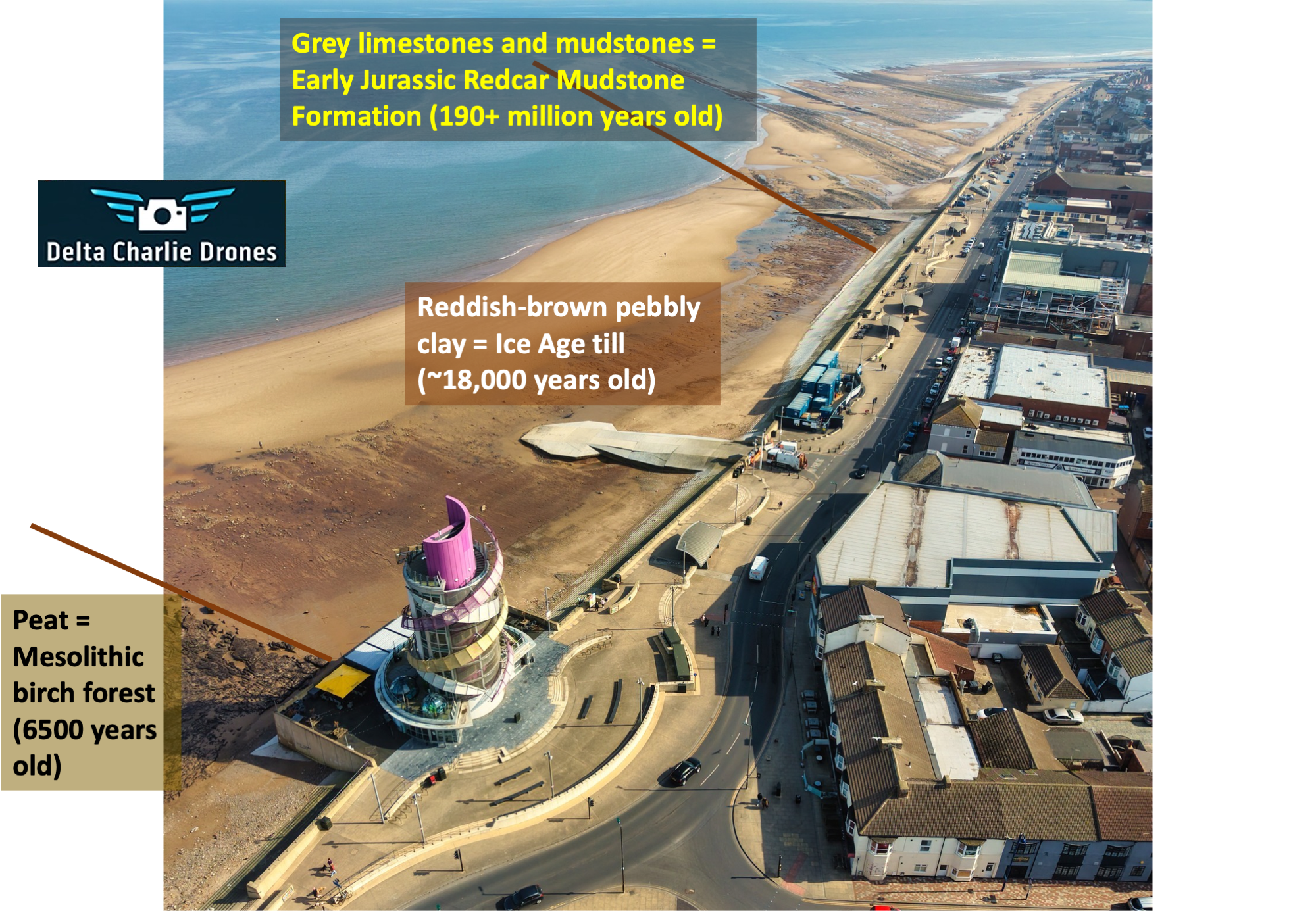
For more detailed geological explanations of each section, see below.
The Mesolithic forest
Having inserted the photo above, I should probably start with the youngest part of the stratigraphy. Dark brown peat, packed full of twigs, trunks and tree stumps, is often exposed on the beach below Redcar Beacon by winter storms. What I’d never seen before this year was tree-trunked peat also exposed at the Zetland Park end of the beach.
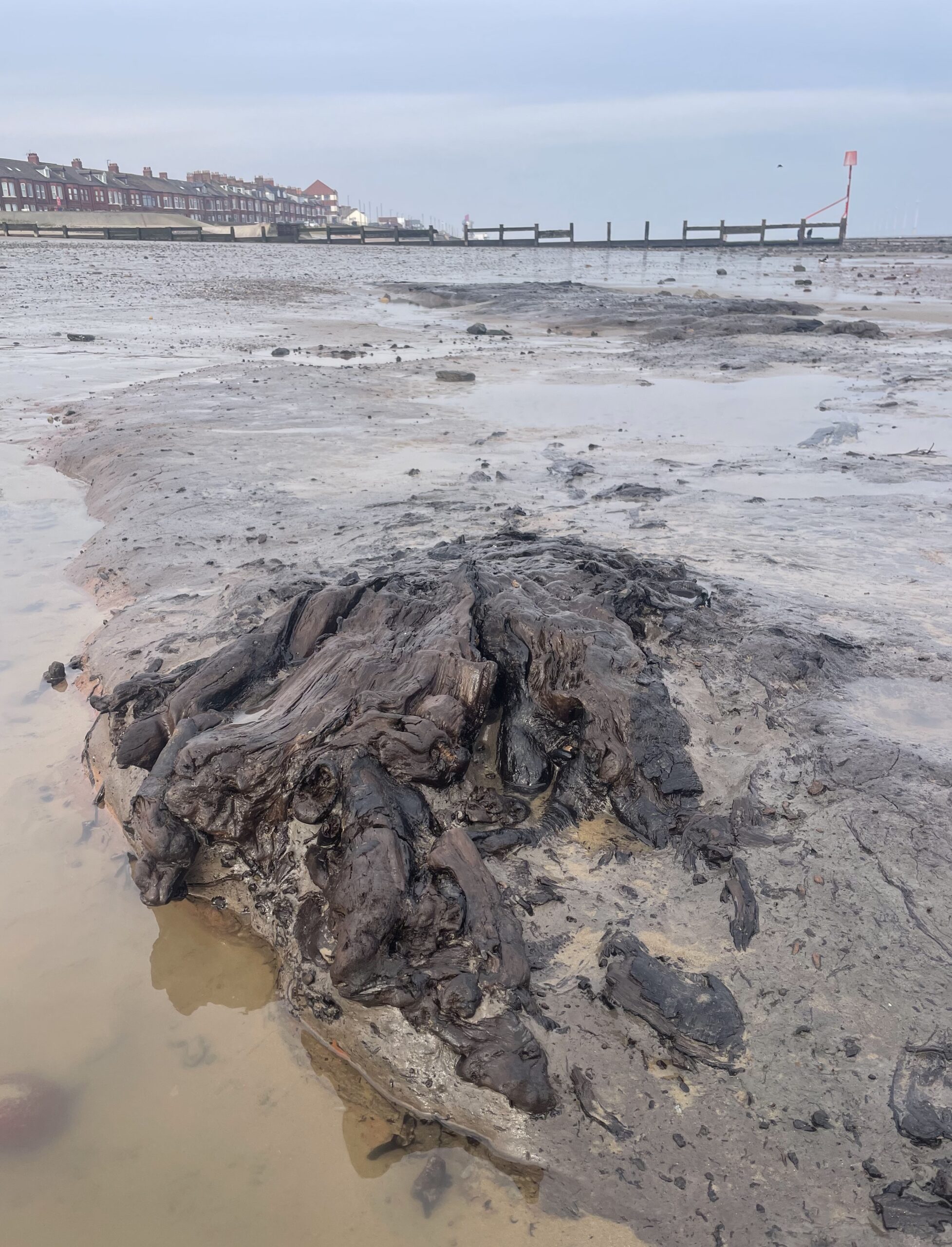
It is not, as often claimed, a petrified forest. The trees, which are mostly silver birches, would have to have turned to stone for this to be correct and they are definitely still woody. It is best described simply as a prehistoric forest. In 2019, archaeologist Steve Sherlock used radiocarbon dating to establish how old the birch trees were. His analysis came back with an age range of 6463-6689 years old, making it a Mesolithic, or Middle Stone Age, forest. Presumably, sea-levels then rose around this time, and the trees were killed off.
As far as I can tell, only trees, leaves and seeds have been found at Redcar so far, but a similar-age forest at Hartlepool, just across the Tees estuary, has yielded evidence of Mesolithic people. So keep your eyes peeled!
UPDATE, 6th October 2026 – A 2014 report by archaeologist Spencer Carter records that, in 1986, an axe head was found in the Submerged Forest at Redcar; and 4 flints were discovered in 1996. Animal remains were also found in the 20th Century, including red deer antlers and wild boar tusks!
Glacial till
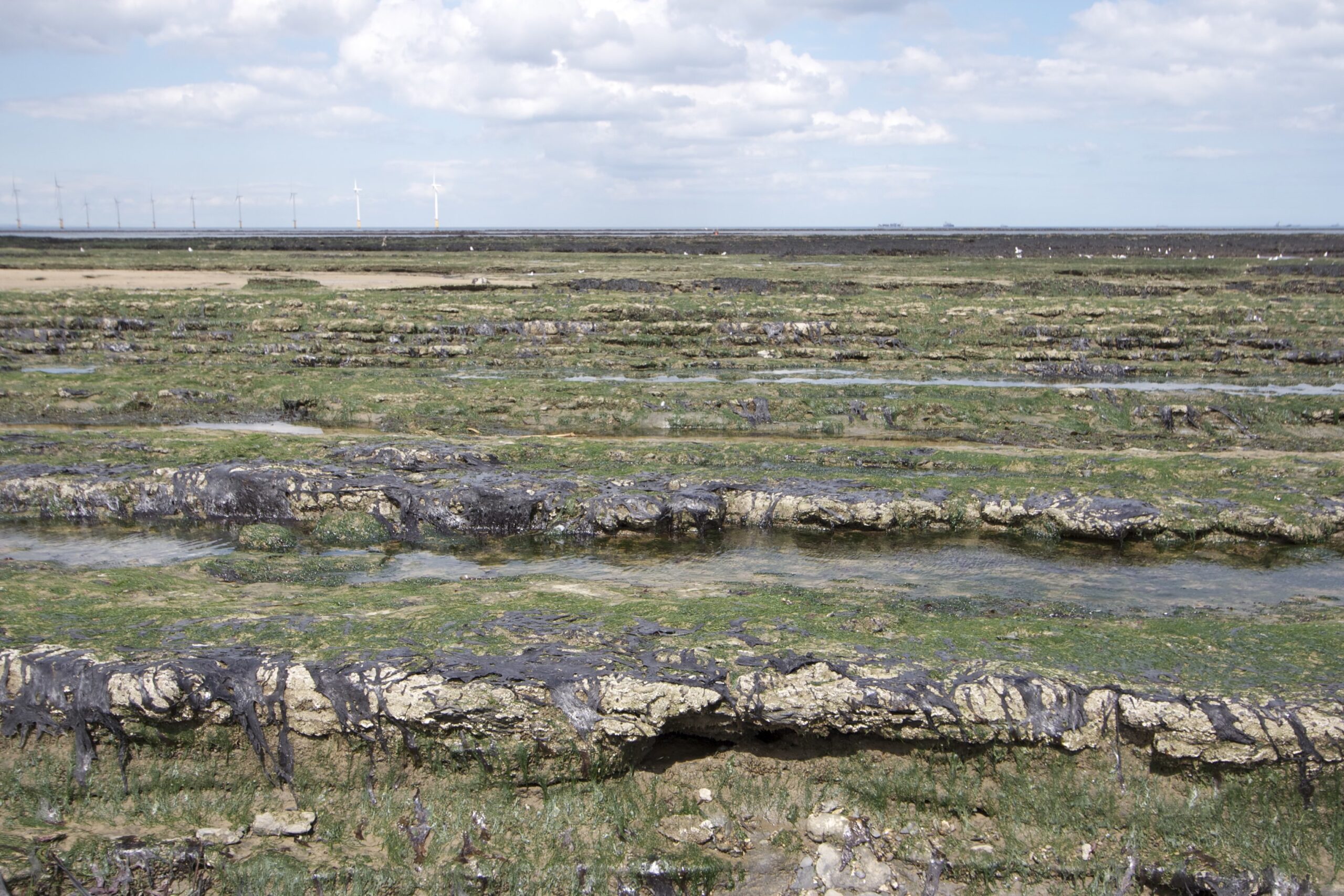
If you see the peat, you will almost certainly also see the reddish-brown beds of pebbly, cobbly clay beneath it (see photo below). This is glacial till, formed during the last Ice Age, 15-20,000 years ago.
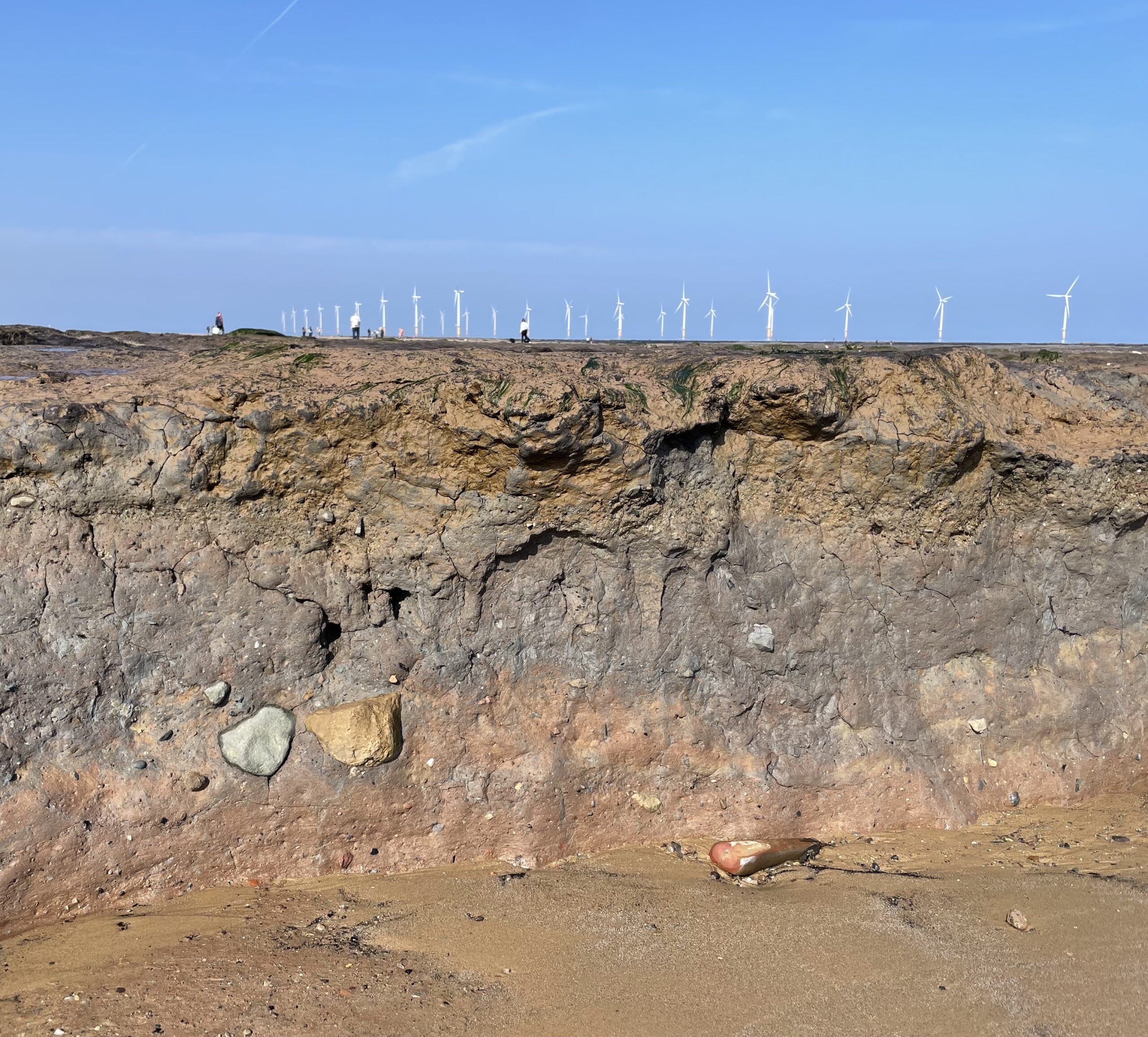
(The wind turbines are actually offshore, but I liked the confusing perspective and scale.)
Glacial till is often referred to as boulder clay, and Redcar’s till fits that description quite well. A wide variety of pebbles, cobbles and boulders can be found in the firm, reddish-brown clay. They include igneous and metamorphic rocks from Scotland, Palaeozoic sedimentary rocks from northern England, and a fair few fossils. One of the most distinctive specimens you can find is the Carboniferous rugose coral Siphonodendron, which is more than 100 million years older than any of the local bedrock fossils (which we’ll come on to in a moment).
The reddish colour to the clay is probably the result of the glaciers smashing up the local, soft, Triassic mudstones and sandstones. These were formed in an ancient desert and are full of iron oxide minerals. It is possible that they put the red in Redcar (the name means either red-marsh or reed-marsh).
Jurassic bedrock
What is definite is that the Jurassic put the rocks in Redcar Rocks. And what a splendid stack of strata these Early Jurassic mudstones, limestones and sandstones are. The fossils they contain are my particular interest, but to begin with, we need to explain the geology.
For depth and detail, I recommend reading Jed Atkinson and colleagues’ paper from 2020. For this blogpost, it is probably sufficient to know that the Jurassic rocks of Redcar are all sedimentary and were laid down quite early in the Early Jurassic (between 198 and 187 million years ago, or thereabouts) in a warm, shallow, stormy sea. Geologists call this the Cleveland Basin and it existed pretty much throughout the Jurassic and Cretaceous periods.
How did the Cleveland Basin come into being? In the break-up of Pangaea, essentially. This supercontinent had formed by tectonic forces smashing lots of other continents together. Eventually, however, Pangaea became gravitationally unstable, and rifts began to develop in the crust. These became low-lying, subsiding regions where water and sediment could pile up. One of them was the Cleveland Basin; a sort-of great-grandparent to the present-day North Sea.

Proto-Yorkshire was much further south 200 million years ago than it is today. The climate would have been Mediterranean-like, with plenty of mud and silt washing off the land into the warm sea-waters, forming what we now call the Redcar Mudstone Formation. It’s not all mudstone, though: over thousands and thousands of years conditions oscillated between warmer and cooler periods, with higher then lower sea-levels. In shallower and/or stormier conditions, greater quantities of sand were deposited.
If you walk across Redcar Rocks you’ll see the rock types repeat themselves over and over again, with the layers forming steps. The coarser-grained limestones and sandstones are tougher, so they stick out; the finer-grained silt- and mudstones are softer, so they weather back. Moving east, with each step down you are going further back in time, earlier into the Early Jurassic. We can’t date the rocks directly – all the sedimentary grains are recycled from older rocks – but from global comparison we know the lowest levels of the Redcar Mudstone Formation were formed during the Hettangian stage, very close to the start of the Jurassic period.
We might not be able to date the rocks of Redcar directly, but we can still build a detailed picture of how things change from the lowest layers to the highest thanks to the fossils. As a palaeontologist, I am biased, but Redcar’s fossils are fabulous, and more easily found on the town’s beaches than anywhere else I know of in Britain. If you want a family-friendly fossiling trip where EVERY SINGLE PERSON IS ABSOLUTELY GUARANTEED TO FIND JURASSIC FOSSILS then Redcar Rocks should be top of your list.
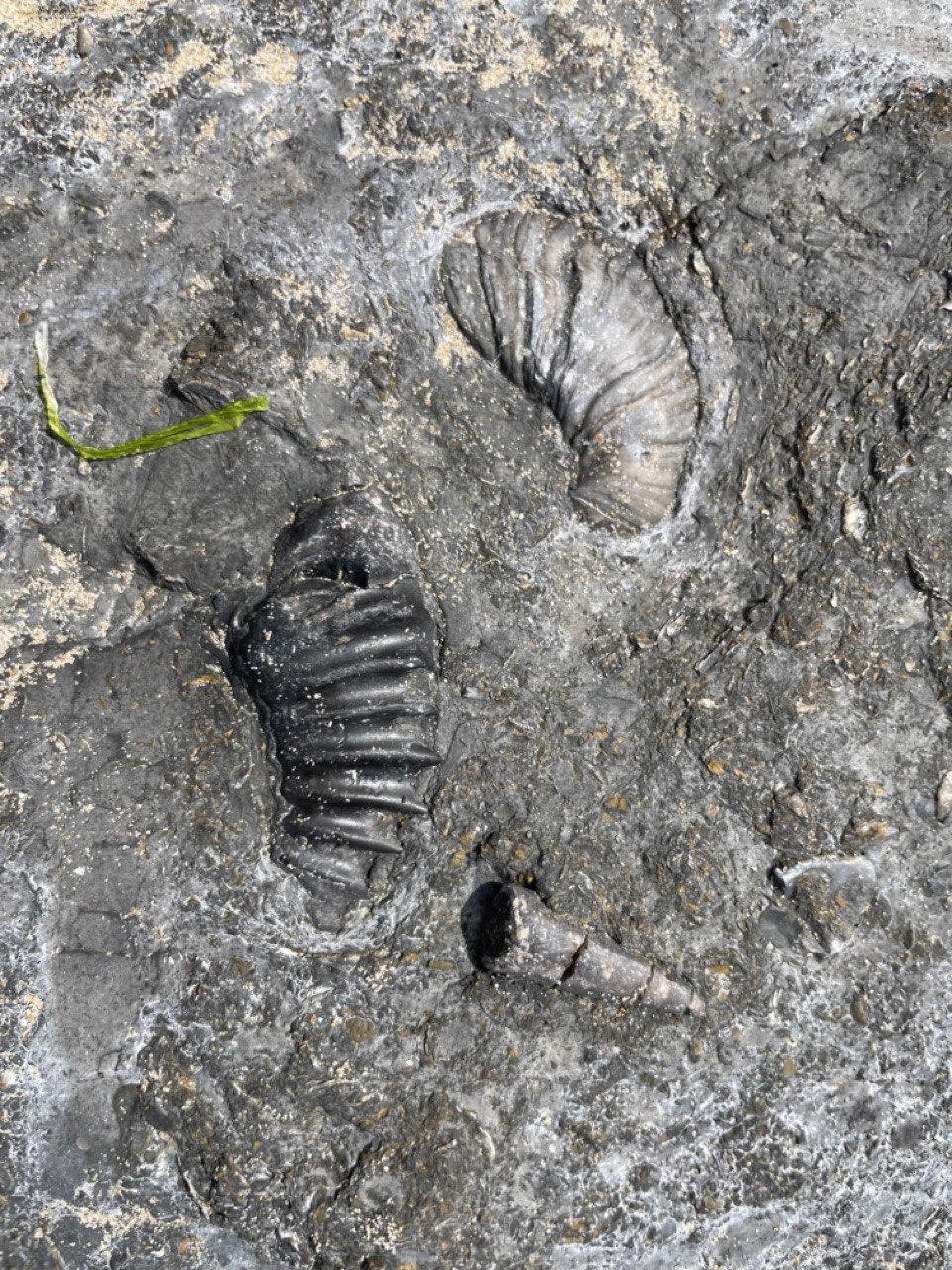
The fossils you’ll find are mostly molluscs. Of the molluscs, mostly bivalves. And of the bivalves, mostly Gryphaea arcuata. But though these Early Jurassic oysters – typically known as devil’s toenails – may be incredibly common, they are nonetheless amazing. Despite being over 190 million years old, their shell mineral – calcite – is basically unchanged since the time it grew. That means Earth scientists can slice a Gryphaea fossil in half, drill tiny amounts of calcite out of each layer, analyse it chemically, and work out what the seawater temperature was (OK, that study was based on French specimens, but the principle holds). Similar detective work also reveals that Gryphaea added mineral layers to its shell throughout the Jurassic year, enabling how long they lived for to be calculated too. Some of them made it to 20!

I could rave about Gryphaea for many pages, but let’s give the other molluscs a look in. The next most common bivalve in the Redcar Mudstone Formation is Cardinia listeri, or ‘Mr Lister’s little hinge’. Whilst Gryphaea lived resting on the seabed, Cardinia has a shell shape that indicates it was a shallow burrower. We begin to tease out a picture of different Early Jurassic sea creatures occupying different niches.

Talking of Early Jurassic sea creatures occupying other niches, ammonites are the beasties that most fossil-hunters want to find. Redcar might not have the spectacular ammonite nodules seen at Whitby, but it has no shortage of lovely specimens, including some absolute whoppers. I’m afraid I am rubbish at ammonite identification, so I tend to refer to most of them as ‘arietitids’. If you want an authoritative guide to Yorkshire ammonites, I heartily recommend this website.
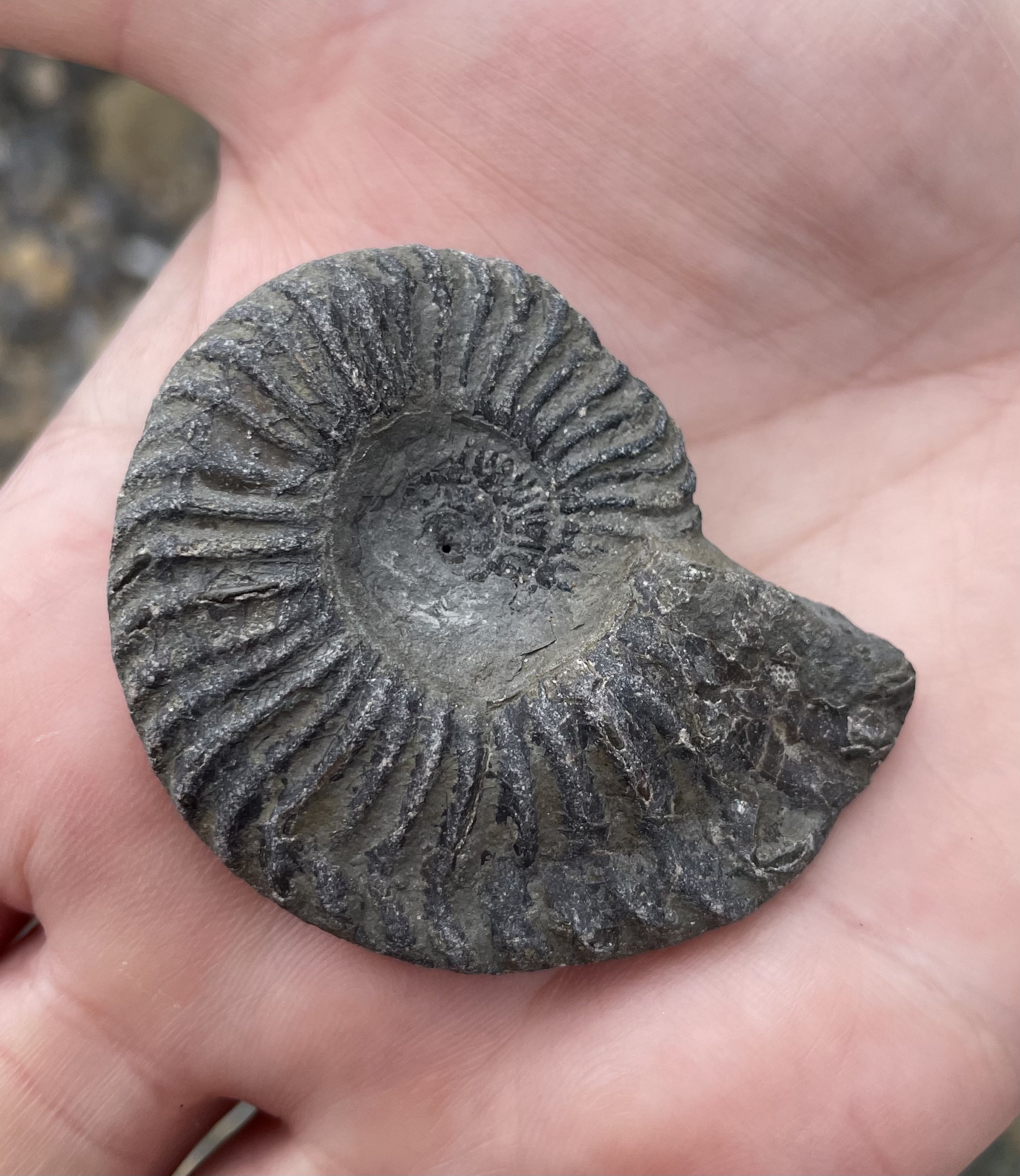
If you want to go beyond ammonites and bivalves, you’re in luck. Redcar Rocks serve up plenty of other things, including belemnites, crinoids, gastropods, fossil wood and – occasionally – marine reptile bones. There are lots of interesting trace fossils too. When you’ve finished walking over the bedrock and you’re approaching the Stray and Zetland Park, make sure you stop on the banks of shingle and have a pick through. In a few minutes you’ll probably amass quite a haul!
Tectonics
Now I am no structural geologist. However, I have been asked a fair few times how these early Jurassic rocks, which were formed under the sea and then buried, ended up back at present-day sea-level; why the Redcar Rocks strata get older as you walk east/south-east (rather than younger as is normal on the Yorkshire Coast, and indeed in the UK); and why some of the beds are not only tilted, but curved. My answer is typically something like this:
- Redcar’s early Jurassic sediments had to be buried to at least three or four kilometres’ depth in order to be lithified (turned to stone). This would have taken millions of years. The sedimentary rocks could then have stayed buried, but over the last 60-odd million years, Africa and Europe have been smashing into each other. Though Cleveland is now a long way away from the Mediterranean, the enormous stresses of this Alpine orogeny have helped push Redcar’s rocks back up to the surface. As that happened, softer rocks (such as mudstones) folded whilst harder rocks (such as sandstones) broke. As the Redcar Mudstone Formation is mostly quite soft rock it formed gently tilted, gently folded beds, which we can see at low tide today.
If any passing tectonicists wish to offer a better explanation, though, they are most welcome to.
Bonus content
After you’ve finished your walk, and the tide has come in and Redcar Rocks have disappeared back beneath the waves, the geology doesn’t have to stop. If you’re strolling along the esplanade back to the Beacon and you notice curious patterns in the paving slabs and some of the shelters, take a closer look. The patterns are Carboniferous fossils, mostly brachiopods and corals, and they’re very similar to some you can find in the shingle on the beach. The difference is that whilst the beach ones are glacial erratics, brought to Teesside by ice, the ones in the seafront are from western Ireland, brought to Teesside by 21st Century people (and sometimes guarded by penguins).

Redcar really is a remarkable place.