
Starlings in deep time

I was recently re-reading James McKay and Roger Osborne’s excellent – and now award-winning – book, Yorkshire’s Amazing Dinosaur Coast, and I realised that one of James’ paintings showed elephants being mobbed by starlings in interglacial Sewerby. I was suddenly reminded of the upcoming “Common Stars” exhibition at Redcar Palace, celebrating the remarkable bird that is Sturnus vulgaris: the common starling.
I also remembered that I’d promised to investigate the fossil record of starlings in Britain in the run-up to the exhibition launch. So here I am, hurriedly trying to do so.

I should probably begin with the starling family tree. All starlings belong to the Sturnidae, a group within the passerine or ‘perching’ birds. Their closest non-starling relatives are mockingbirds and thrashers, which, together with thrushes, flycatchers and dippers, form the Muscicapoidea. This name sounds very fancy, but just means ‘fly-catcher-like’.
In a 2008 study, Irby J. Lovette and colleagues described starlings as having ‘radiated impressively’ across Europe, Africa and Asia, with one particular branch of the family being especially successful. These ‘disturbed habitat specialists’ that are ‘at least partially nomadic or migratory’ and breed or flock together are the Eurasian starlings, with more than 20 different species known.
Being diverse, numerous and widespread, such creatures stand a reasonable chance of having a fossil record. Searching the scientific literature for British examples, I was quickly pointed towards Norfolk, and Professor John Stewart‘s 2010 study of the fossil birds of the West Runton Freshwater Bed. During a (mostly) warm period more than half-a-million years ago, a large, dynamic river system – sometimes known as the Ancaster River – flowed across what is now northern East Anglia.
Many different fossils have been found in the West Runton Freshwater Bed, the most famous being the West Runton Mammoth. But for this post we’re going to overlook giant mammal skeletons and focus instead on small bird legbones. The figure below is from Stewart (2010) and shows a ‘proximal right humerus of Sturnus sp.’ or the upper right wing bone closest the shoulder of a starling species.
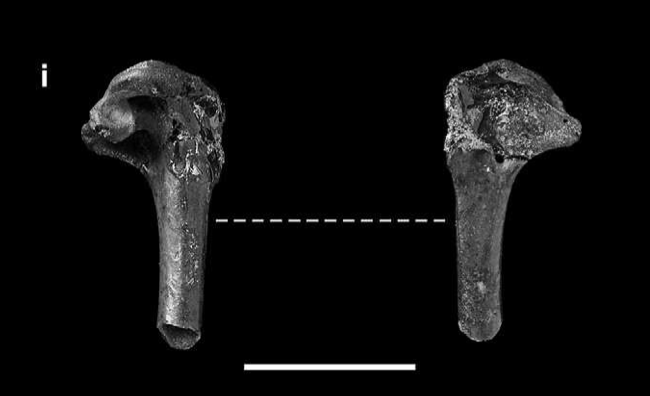
In the discussion, Stewart comments that Sturnus and Turdus (thrush) bones can be hard to distinguish, but that there are a couple of key features that indicate this was a small starling, similar in size to S. vulgaris or Pastor roseus, the rosy starling. Stewart notes also that other British fossil starlings of a similar age, known from south-west Britain, are larger. Small starling species are more likely to be migratory, he adds, so perhaps this was true of the Norfolk ones too. Excitingly, Stewart (2010, p. 85) concludes by saying that the common starling will ‘eat ectoparasites off the backs of large herbivorous mammals.’ This takes us rather nicely back to James McKay’s illustration.
Formed rather more recently in Pleistocene time – 40-55,000 years before present, rather than half-a-million years ago or more – and during a much colder period, the cave deposits of Pin Hole, Creswell Crags, Derbyshire have also yielded starling bones among their bird fossils. These were described by Stewart & Jacobi in 2015, who identified nine specimens as belonging to Sturnus species.
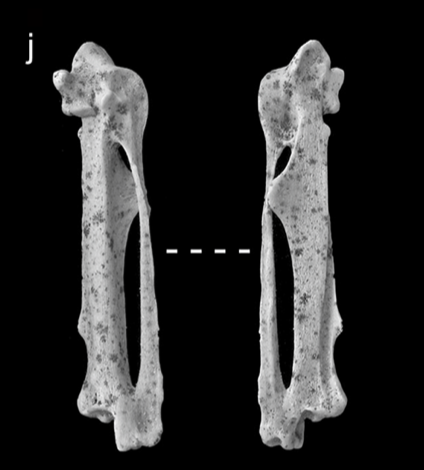
Again, the bones were interpreted as being too small to be Sturnus unicolor, the spotless starling, and were therefore likely to be either common starlings or rosy starlings. Environmentally, these two starlings have rather different preferences: common starlings like open woodlands and grasslands, whilst rosy starlings live in semi-desert and steppe habitats, and only the former is normally found in the UK. However, both species tend to be migratory. Stewart & Jacobi note that comparing the distribution of fossil starlings with their modern genetics and geography presents quite a complicated picture, but that starlings were clearly widely distributed across Europe tens of thousands of years ago.
Talking of Europe, a fossil starling from north-east Bulgaria was described in 2020. The bones were found in a limestone layer deposited during the middle of the Miocene period. OK, it’s an extinct species and there’s no evidence it ever lived in Britain, but this splendid ancient bird is around 12 million years old!
If we want to remain steadfastly insular, we can’t take British starlings that far back. However, we can definitely still say that starlings have lived here – probably on and off – for hundreds of thousands of years, accompanying elephants in the warm wetlands of Norfolk, and dwelling alongside all manner of mammals (including humans) near the cool caves of Derbyshire. Now all we need is for someone to dig up a specimen from the prehistoric forest of Redcar foreshore…


