
Geology of Runswick Bay

A post for International Geodiversity Day 2025
Runswick Bay is one of the most popular, picturesque places on the Yorkshire Coast, and its appreciation seems to have increased since Covid. It is especially appreciated for its fossils, but they are only part of a geological story almost 200 million years in the making.
To begin the tale, we have to go back to the Early Jurassic. The world was recovering from the end-Triassic mass extinction. The supercontinent of Pangaea was beginning to come apart. And Yorkshire was in the Mediterranean (sort of).

At a subtropical latitude, with shallow seas surrounding fragmented landmasses, sealife flourished in Jurassic Yorkshire’s well-oxygenated waters. The mudstones, shelly sandstones and oolitic ironstones of the Cleveland Ironstone Formation were being laid down. Much of this sediment had passed through the guts of the innumerable marine animals. “Chew, poo, and glue!” as Dr Brooke Johnson memorably explains it:
The indigestible iron and silica became concentrated in the seabed: miners of Yorkshire’s Early Jurassic seabeds created mineral layers that miners of Yorkshire’s Industrial Revolution were able to exploit, millions of years later.
But then, disaster! South Africa and Antarctica began rifting apart, belching huge quantities of greenhouse gas into the atmosphere. Rapid global warming! Sea-level rise! Storms and floods! Rivers washed tonnes of nutrient-rich sediment into the seas and algae bloomed in the photic zones. Oxygen was used up, and a Toarcian extinction event began.
Down at the seabed of the Cleveland Basin, sediments became a stormy, stinky soup. Almost nothing could live there, and a cool place for creatures became an almost-permanent graveyard. Awful for Jurassic sealife; fab for fossilization. Ammonites, belemnites, crocs and jet: preserved for posterity.

Things took hundreds of thousands, probably millions, of years to recover. Indeed, in the rocks of Runswick we don’t really see the recovery. Even at Kettleness, where the vast old alum quarries create a lunar headland, the upper parts of the cliff are still chemically and biologically odd. Only at Blea Wyke, at the south end of Robin Hood’s Bay, can scientists study the whole story.
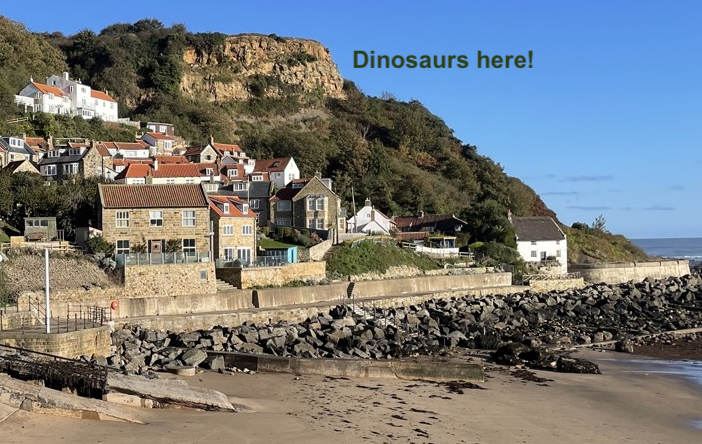
Recovery definitely happened though, eventually, and new animals evolved and sea-levels fell. The sandstones that top the cliff above Runswick village are mid-Jurassic in age. They preserve evidence of a richly vegetated, dinosaur-trampled coastal plain. Keep your eyes peeled for fallen blocks of the true dinosaur coast!
Rock-wise, that’s as far as the Jurassic goes in Runswick, but the geological story doesn’t stop. For all the sediments had to be buried – several kilometres – in order to become sedimentary rock, and that took millions of years. Then, for the rocks to return to the surface, you need not just time, but tectonics.
Yorkshire might seems a long way from the Alps or Pyrenees, but the stupendous force of Africa colliding with Europe is what pushed our rocks back up again. Tectonics is also what created the Runswick Bay fault, a great crack that runs roughly north-south through the western edge of the bay. It seems to have formed between 20 and 45 million years ago, as Cleveland’s crust got stretched by the opening of the Atlantic Ocean. No earthquakes these days, thankfully.
Don’t rest easy, though. There are plenty of rockfalls and landslides. In 1682, almost the entire village slid into the sea, whilst Kettleness alum works suffered a similar fate in December 1829.
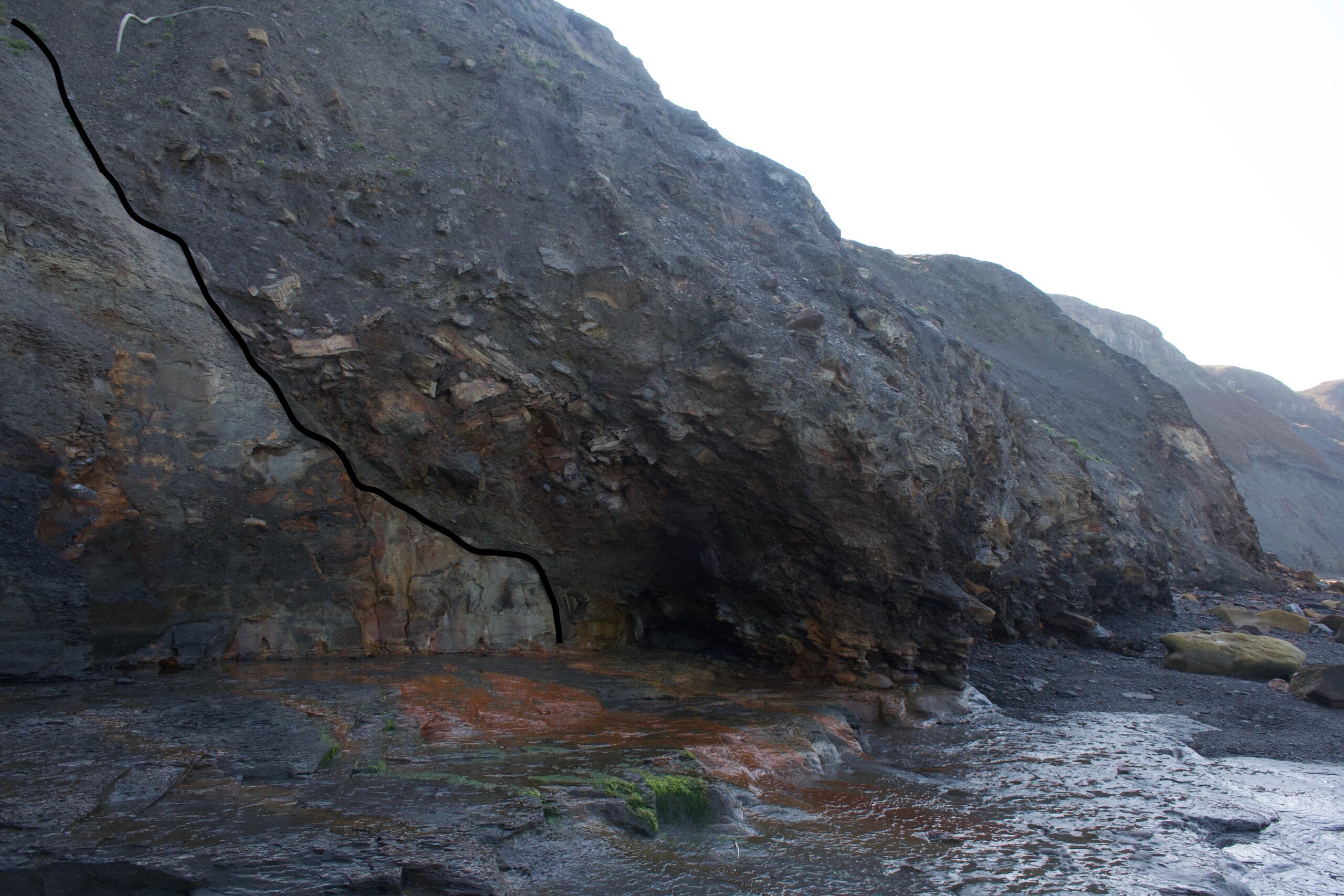
Tectonics are partly responsible for these collapses, but there’s another agent involved too: ice!
In the curving centre of Runswick Bay, the cliffs aren’t rock but clay, deposited 20-odd thousand years ago as glaciers moved down what is now the Yorkshire Coast. They exploited whatever weaknesses they encountered in the rocks they moved over, and plastered sticky debris on top of them: glacial till if you’re being proper. Boulder clay if you’re not.
Either way, this brown, mucky, cobbly blanket often slips and slides. Not great for coastal stability, especially with the increasingly warm, wet and stormy conditions brought on by man-made climate change, but excellent for bringing new fossil material down onto the beach. The Ice Age pebbles are often palaeontological, so at Runswick Bay you get two bites of the cherry: Jurassic and erratic. Just don’t tell anyone.

Given the geodiversity of Runswick Bay, surprisingly little of it is officially protected for its geological or palaeontological importance. Everything below the high-tide line is part of a Marine Conservation Zone. Above the high-tide line, you’re on the heritage coast, or in the national park, or on private land, but only a small section of cliff and scar to the north of the village has SSSI status. But let’s put our best-practice hats on, and treat this beautiful bay as though it DOES have proper geoheritage recognition.
And if you’d like to learn more about the Geology of the Yorkshire Coast, Pete Rawson and John Wright’s 4th edition of the Geologists’ Association field guide is well worth buying.


.png)